
Roots
Where the practice comes from: a sage who set down yoga in under two hundred short lines, and a teacher who spent a lifetime finding what they mean in the body.
Sage Patanjali
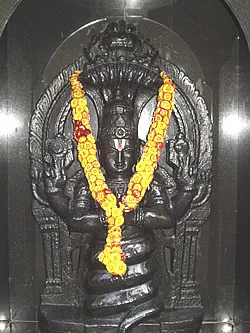
Patanjali is the sage credited with the Yoga Sutras, the short text on which the philosophy of yoga rests. He defined yoga as chitta vritti nirodha , the stilling of the movements of the mind, and described eight limbs, or ashtanga , that lead there. The verse below is the traditional invocation to him.
योगेन चित्तस्य पदेन वाचां
मलं शरीरस्य च वैद्यकेन ।
योऽपाकरोत्तं प्रवरं मुनीनां
पतञ्जलिं प्राञ्जलिरानतोऽस्मि ॥
yogena cittasya padena vācāṁ malaṁ
śarīrasya ca vaidyakena
yo'pākarottaṁ pravaraṁ munīnāṁ
patañjaliṁ prāñjalir ānato'smi
Let us bow before the noblest of sages, Patanjali, who gave yoga for serenity and sanctity of mind, grammar for clarity and purity of speech, and medicine for perfection of health.
The legend
Tradition tells how Patanjali came into the world.
-
1
A dance
Adisesa, the serpent on whom Lord Vishnu rests, watches Lord Shiva's dance. Vishnu is so absorbed that his body begins to vibrate with the rhythm and grows heavy, and Adisesa struggles to bear the weight.
-
2
A wish
When the dance ends, Vishnu is light again. He explains what happened. Adisesa longs to learn dancing, and Vishnu foretells that he will first write a work on grammar.
-
3
A mother
Adisesa meditates to find who will be his mother, and sees Gonika, a woman yogini praying for a worthy son to whom she can pass on her knowledge.
-
4
A handful of water
At the end of her penance Gonika offers water to the Sun in her cupped palms. A tiny snake falls into them and takes human form, and bows to her.
-
5
A name
She names him Patanjali: pata, fallen, and anjali, palms folded in prayer.
The Yoga Sutras
The Sutras are a famously compact text: 196 short aphorisms, in four chapters. Most yoga traditions draw on them.
- Samadhi Pada On absorption
- Sadhana Pada On practice
- Vibhuti Pada On the fruits of practice
- Kaivalya Pada On freedom
Bellur
Bellur is a village in Karnataka, and the birthplace of B.K.S. Iyengar. On 31 October 2004 he inaugurated there what the institute describes as the world's first temple of Sage Patanjali, with a carved black-stone image of the sage. It stands in a temple complex that includes a Hanuman temple said to be 800 years old.
A charitable trust, the Bellur Krishnamachar & Seshamma Smaraka Nidhi Trust, works for the village. Its projects include a hall where children from Bellur and nearby villages learn yoga, a 50,000-gallon tank that supplies drinking water, and a high school for girls.
Guruji
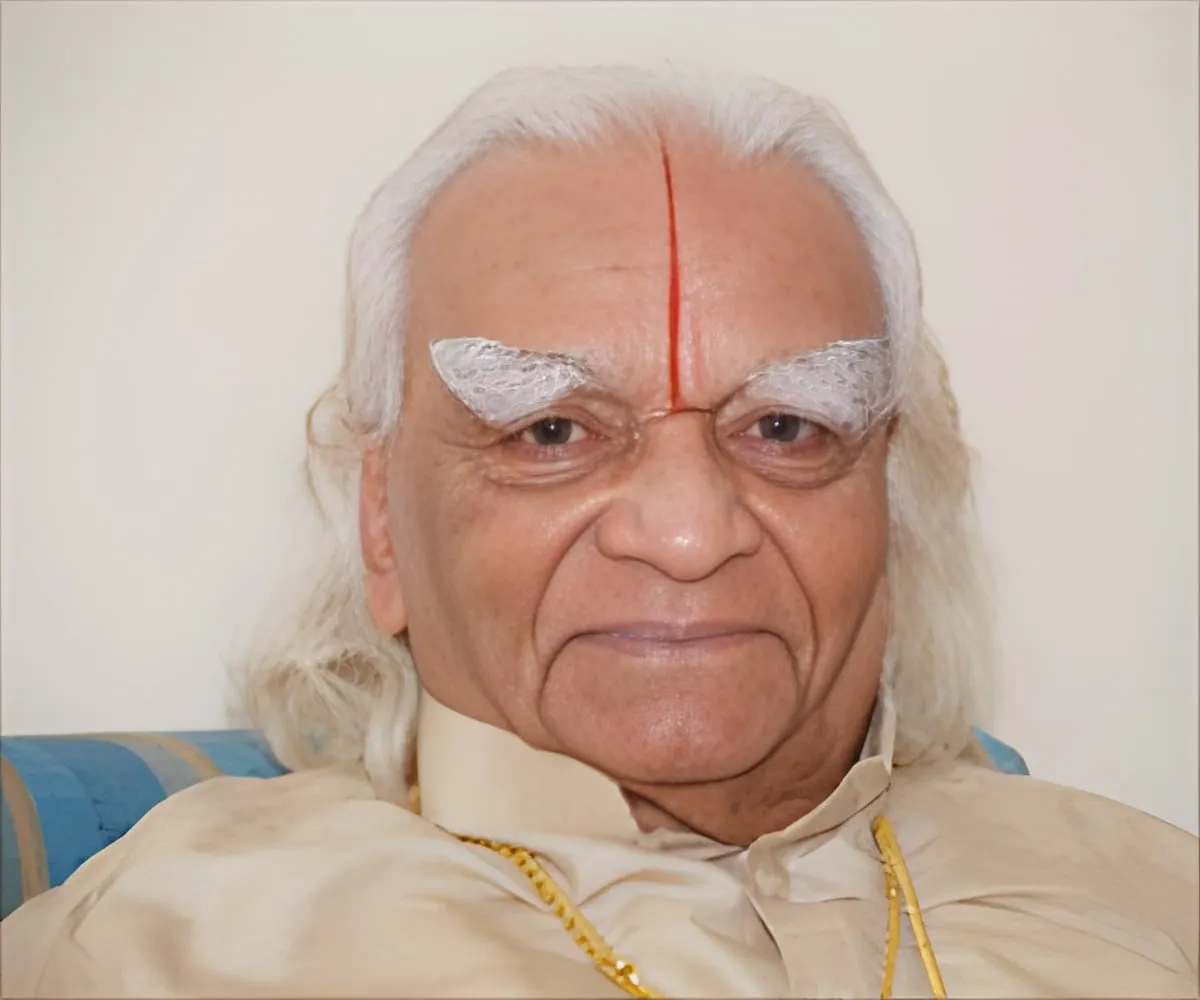
B.K.S. Iyengar, whom his students call Guruji, shaped the method that carries his name. He gave it two things: precision and alignment in every posture, and props he designed himself, such as wooden blocks, belts and ropes, so that people of every kind could practise safely. The institute describes his method as grown from "research-based experience and experience-based research".
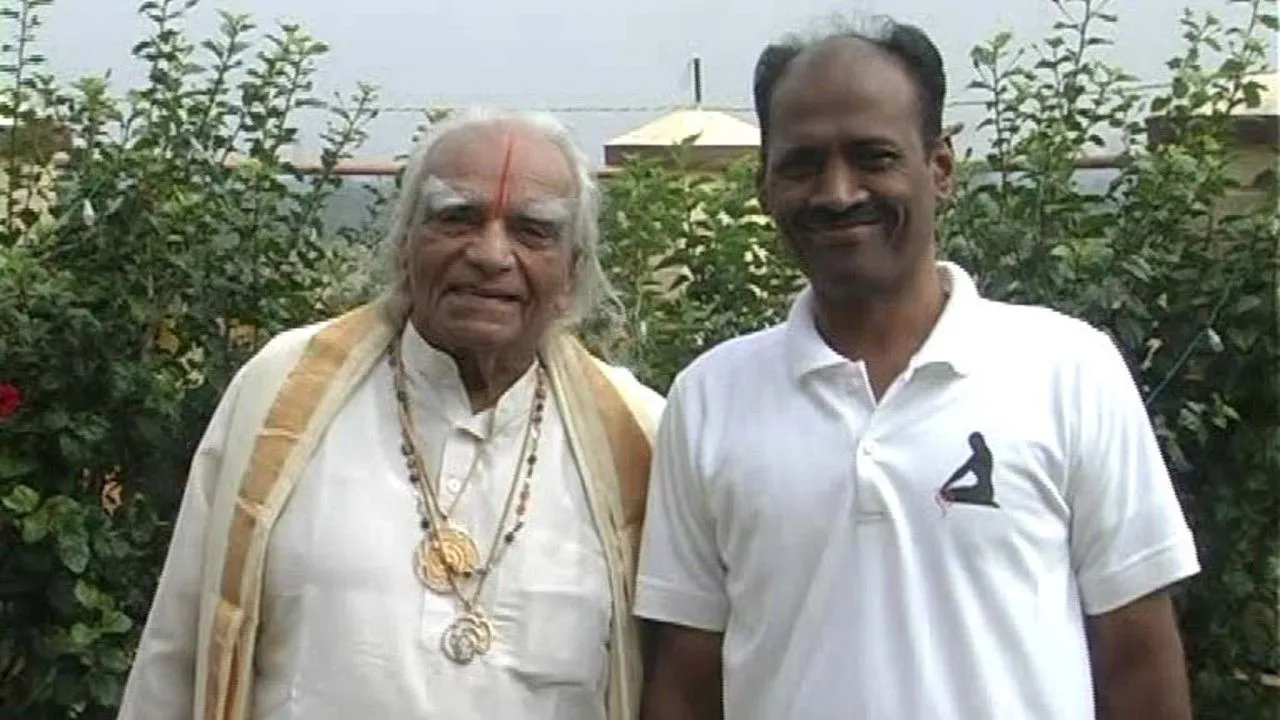
Narayan Sir learnt directly from him, for decades.
A life in dates
- 14 December 1918 Bellur Krishnamachar Sundararaja Iyengar is born in Bellur, Karnataka. His father is a schoolteacher.
- Childhood He suffers malaria, typhoid and tuberculosis.
- Aged 16 He is introduced to yoga by his teacher, Sri T. Krishnamacharya.
- Aged 18 He is sent to Pune to teach, because he knows a little English.
- 1943 He marries Ramamani. They have five daughters and a son, Prashant.
- 1952 He meets the violinist Yehudi Menuhin, who helps introduce him to the Western world.
- 1966 Light on Yoga is published and carries the method across the world.
- 1973 and 1975 The foundation stone of the Ramamani Iyengar Memorial Yoga Institute is laid in 1973. It is inaugurated on 19 January 1975.
- 1998 On his 80th birthday he teaches 800 students for a week in Pune.
- 2000 He holds a special course for senior teachers from nearly forty countries.
- 2003 The Oxford English Dictionary includes the word Iyengar.
- 2004 He inaugurates the Sage Patanjali temple in Bellur. TIME magazine names him among the world's most influential people.
- 2014 Guruji passes away. The teaching carries on, hand to hand, through his students.
In Guruji's words
The institute in Pune
The Ramamani Iyengar Memorial Yoga Institute, named for Guruji's wife, is the heart of Iyengar yoga. Even its design carries the teaching.
- 1 Yama
- 2 Niyama
- 3 Asana
- 4 Pranayama
- 5 Pratyahara
- 6 Dharana
- 7 Dhyana
- 8 Samadhi
Books
Guruji wrote at length on practice, the breath and the Sutras. A few places to begin reading:
The postures
- Light on Yoga
- Yoga: The Path to Holistic Health
- Iyengar Yoga for Beginners
- Art of Yoga
The breath
- Light on Pranayama
The Yoga Sutras
- Light on the Yoga Sutras of Patanjali
- Core of the Yoga Sutras
Living the practice
- Light on Life
- Body the Shrine, Yoga thy Light
- Light on Ashtanga Yoga